Why Data Centers Can't Wait for Traditional Energy: The Fusion Solution
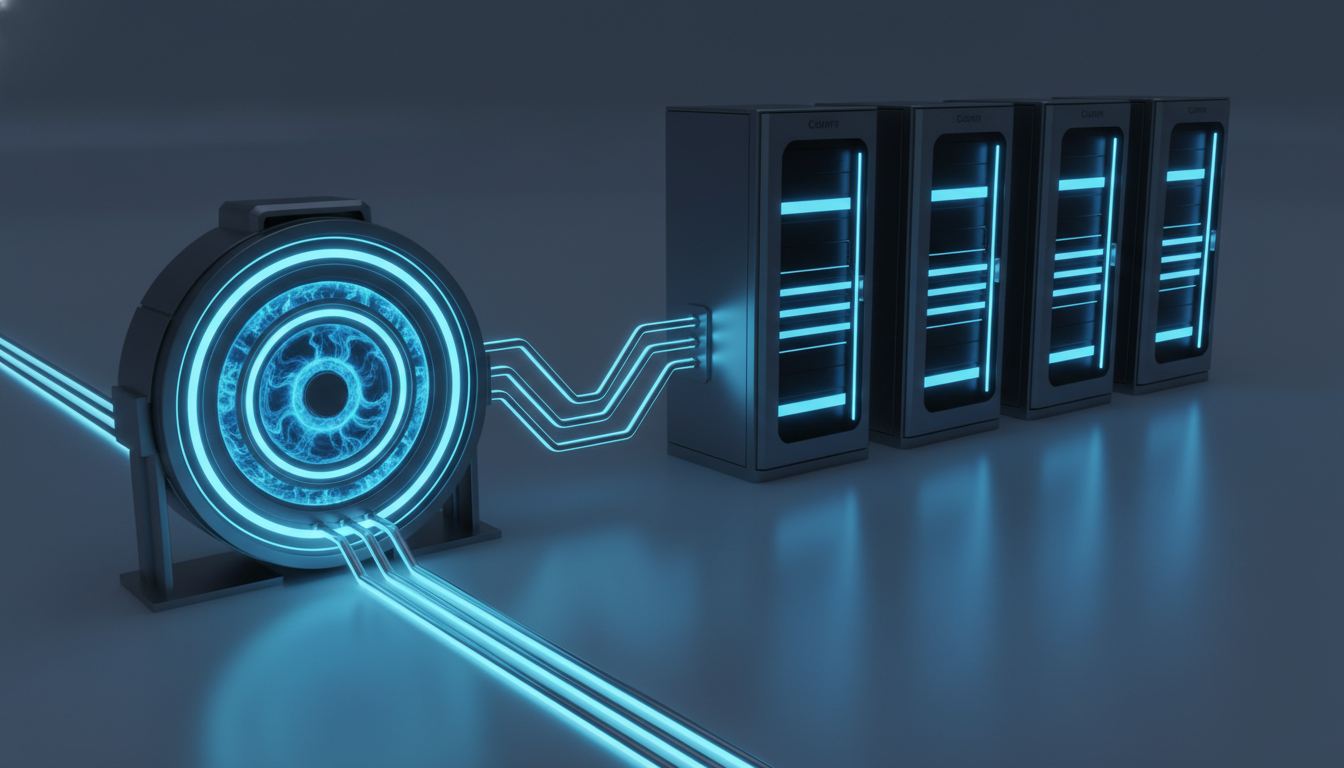
Why Data Centers Can't Wait for Traditional Energy: The Fusion Solution
Data center operators face an impossible choice between reliability and sustainability. US data center demand will rise to 75.8 GW in 2026 and further expand to 134.4 GW in 2030, yet global electricity use by data centers reached an estimated 415 TWh in 2024, representing around 1.5% of worldwide electricity demand. The scale isn't just massive—it's accelerating at an unprecedented pace.
The 100-500MW Reality
Hyperscale data centers require at least 100 megawatts of electric power, with some facilities exceeding this threshold significantly. These aren't future projections—they're today's operational requirements. Microsoft's campus-level data centers often exceed 70 MW, while Amazon's cloud zones approach 100 MW each.
AI data centers will consume 9% of US electricity by 2030, creating a level of demand that traditional energy planning simply cannot accommodate. The numbers tell a stark story: the IEA now projects global data center electricity consumption will hit 1,100 TWh in 2026, equivalent to Japan's entire national consumption.
The Renewable Energy Gap
Data centers cannot afford intermittency. They need uninterrupted and consistent power 24/7. Fluctuating power is not good for sensitive data center equipment. This fundamental mismatch creates an engineering challenge that even the most sophisticated battery storage systems struggle to solve.
Supplying a datacenter using only intermittent renewables is currently unfeasible, at reasonable cost and reliability, without adding energy storage or conventional generators consuming fossil fuels. Despite massive investments in solar and wind, with current solar technology, battery storage capabilities, and current and forecasted power usage, data centers cannot solely run on solar power -- especially if it's a large-scale or hyperscale facility.
The intermittency problem isn't theoretical—it's operational reality. Solar installations produce only about 25% of their theoretical maximum capacity over time, and wind patterns fluctuate unpredictably. Many renewable energy sources, like wind and solar, are intermittently available. Only geothermal provides a steady, weather-independent supply.
Real-World Procurement Pressures
Energy executives at hyperscale companies aren't making procurement decisions based on sustainability goals alone. They're responding to mission-critical operational requirements that can't tolerate power interruptions.
Data centers will increasingly require on-site systems as their power demands outpace the capacity of the grid. Grid constraints have become so severe that Northern Virginia has effectively halted new data center permits due to capacity warnings through 2028.
The GRID Act targets new data centers with power demand of 20 megawatts or more — essentially every hyperscale facility operated by major cloud providers. The GRID Act's core requirement is straightforward but transformative: new qualifying data centers must derive all energy from on-site generation.
The Timeline Urgency
Carbon-neutral commitments aren't distant aspirations—they're immediate business requirements. The top 20 hyperscalers aim to increase their low carbon energy consumption from 88% in 2023 to 100% by 2030.
Microsoft signed a 2 GW nuclear commitment with Constellation Energy through 2040 — the largest corporate nuclear agreement in history. Amazon secured 1.5 GW of dedicated solar in Texas. These massive deals underscore the desperation in the market for reliable, carbon-neutral baseload power.
Fusion: The Missing Baseload Solution
Fusion power addresses the fundamental problem that renewables can't solve: continuous, carbon-neutral baseload generation. Fusion energy, once deployed, may be particularly well suited to power data centers because it can deliver zero-carbon, firm power with a strong safety profile that may allow siting near population centers.
The commercial timeline isn't speculative anymore. Helion began construction of the Orion plant in Washington state, scheduled to deliver 50 MW to Microsoft data centers by 2028 under the world's first fusion power purchase agreement. Commonwealth Fusion Systems' SPARC demonstration facility in Massachusetts is 60% complete, with their commercial ARC facility planned for Virginia in the early 2030s under a 200 MW Google power purchase agreement.
Tech hyperscalers are no longer just funding research; they are acting as the anchor tenants for the first generation of fusion plants. The first fusion Power Purchase Agreements (PPAs) are projected for 2032–2038 at premium baseload pricing.
AI-Native Optimization
What makes fusion particularly suited for data centers isn't just the continuous output—it's the potential for AI-driven optimization. Real-time machine learning algorithms can optimize plasma parameters thousands of times faster than human operators, delivering the 99.9%+ uptime reliability that data centers require.
This AI-native approach creates a symbiotic relationship: data centers provide the computational power to optimize fusion reactors, while fusion reactors provide the continuous, carbon-neutral power that data centers need.
The Economics of Certainty
Data center operators are willing to pay premium rates for energy certainty. The first fusion PPAs are projected for 2032–2038 at premium baseload pricing, with hyperscalers absorbing early capacity for reliability rather than immediate cost parity with natural gas.
This premium pricing reflects the true cost of downtime in mission-critical operations. When a single hour of outage can cost millions in lost revenue, paying 2-3x traditional rates for guaranteed uptime becomes economically rational.
Manufacturing-Ready Deployment
Unlike experimental fusion approaches, purpose-built data center fusion systems can use standardized manufacturing blueprints. This approach accelerates deployment by enabling qualified manufacturers to build proven designs without developing internal fusion expertise.
Modular 100-500MW reactor designs fit within existing data center facility constraints and integrate with current power management systems. This isn't about rebuilding infrastructure—it's about deploying reliable, continuous power within existing operational frameworks.
The Path Forward
Data centers can't wait for grid improvements or battery storage breakthroughs. The energy demand is here now, growing exponentially, and traditional solutions simply don't meet the operational requirements for 24/7 mission-critical computing.
Fusion power represents the convergence of three critical factors: continuous output, carbon neutrality, and manufacturing scalability. For data center operators facing impossible choices between reliability and sustainability, fusion eliminates the trade-off entirely.
Ready to explore how AI-optimized fusion power can solve your data center energy challenges? Learn more about continuous, carbon-neutral baseload solutions at ColdFusion.
Industrial AI-Optimized Fusion Power Systems
ColdFusion delivers AI-native fusion reactor designs specifically engineered for hyperscale data center operations, prov
Discover what we're building
Learn more about Industrial AI-Optimized Fusion Power Systems and get started today.
Visit Industrial AI-Optimized Fusion Power Systems